#6: Error 404 - Speed Not Supported in this Region
- Saylor Stottlemyer
- Jan 19
- 4 min read

Updated: Jan 23
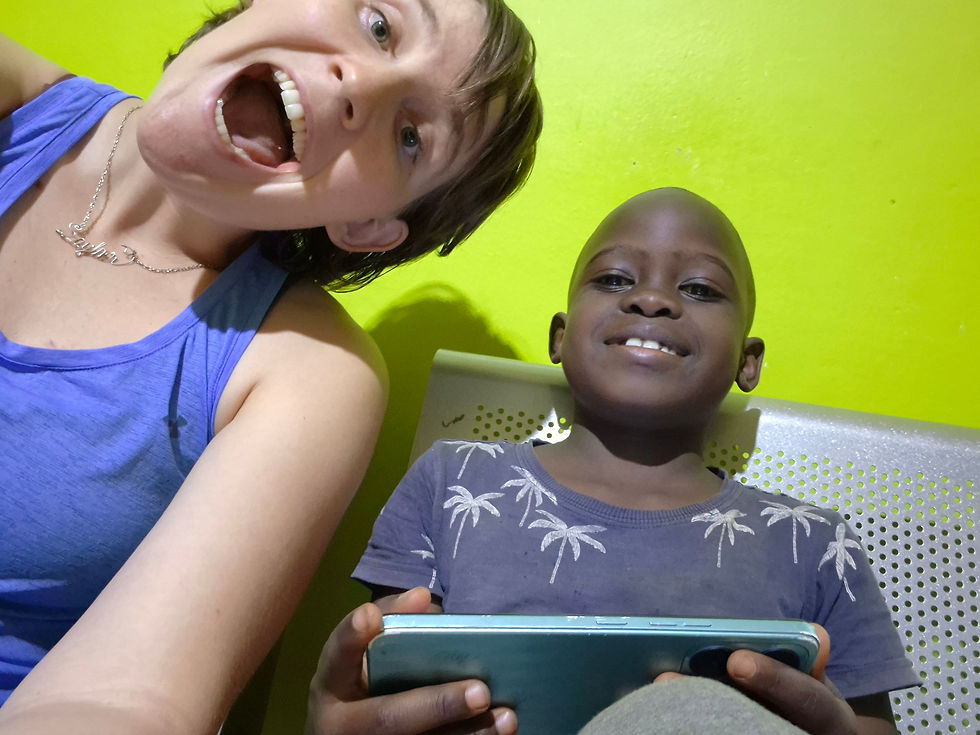
Settling into life here has been both simple and difficult at the same time. Some things have not changed at all — for example, spending time with kids is universal. Henry’s oldest child, Liam Luke (5), is my first friend. We play soccer and gymnastics outside, he tries to download GTA and Mortal Combat on my phone when I am not looking, and he draws with my pens while I work or study. He is easy to be with, endlessly curious, and unintentionally one of my best Runyoro teachers.
The food, on the other hand, has been an adjustment. Thankfully, there are incredible cooks at the hospital, and I usually eat with Henry and his family. His wife, Vivian, makes everything taste wonderful. The only thing I am truly missing is Cholula — it would make some of the starches a little more enjoyable. There are so many fresh fruits and vegetables, most of which I have never tried. Every meal is a surprise, which makes eating feel like a small daily adventure. On my first morning, Vivian kindly made me scrambled eggs and pancakes so I would feel comfortable. I am not sure I will ever fully adjust to the meats — maybe I am a wimp, but I still find them a little disconcerting.
Day-to-day life here runs on what my Aunt Karen perfectly described as “Africa Time.” Everything moves much slower than it does in the United States. It is oddly stress-relieving to be expected to do so little, but also strangely stressful to feel like things are functioning at about 20% capacity. There are no fixed schedules. Meetings happen when they happen. You wake up when you wake up. You can check in, or not. You can stay in your room, or not.
Today, I was going around greeting people in Runyoro, the local language, and Henry gave me one piece of advice: slow down. He told me I was speaking far too fast for anyone to understand. He said African languages must be spoken slowly. This was not surprising — and, as anyone reading this knows, slowing down is not exactly my strong suit. But here, I don’t really have a choice, which might be the point. Yesterday, I spent two full hours simply watching local boys harvest corn at Albertine, corn that we will later sell. I ate some local jackfruit while they worked. No rushing. Just watching. I did the same thing today with the rain. It only rained for one hour, but it was still special to watch.
Medically, I am still learning the ropes. We see typhoid and malaria patients every day, and most arrive with multiple conditions at once. Comorbidities are especially dangerous here. Over the coming weeks, I will shadow doctors, midwives, and nurses — it is just a matter of timing. Today, I chose to take a full MCAT practice exam instead of working at the hospital, which is something I am deeply grateful to be able to do. The hospital itself is remarkably well-equipped. It is the only two-story building for miles. There is an X-ray machine, a dental department, a NICU, a pediatric ward, a laboratory, and a brand-new operating room currently under construction. It should be finished in about a month, and I cannot wait to document its progress.

I have made friends here, too. Mildred, one of the nurses, has been especially kind. There is also Vivian — an 18-year-old high school student from Pakistan and Uganda who is here for just a month to shadow the doctors before graduating and (hopefully) attending medical school. Her life story is mind-blowing: a father in Pakistan who rarely contacts her, a mother who left when she was four, years of being raised by randos before eventually being taken in by a social worker. Listening to her story felt like hearing a villain’s backstory — except she is one of the most loving, joyful people I have ever met. We complain about the bugs together, watched her high-school debate competition on live TV, and talked about life, family, and the future. She has been here for four weeks already and leaves later this week. I will miss her.
Before arriving, I told people that I was committed to learning the local language. I could tell some of them did not really believe me. Either they assumed I would give up, or they did not think it was possible. Today, after watching a few YouTube videos and learning basic greetings, I understood why this matters so much. When I greeted people in Runyoro, their faces lit up. They knew I was serious. Now, everyone is teaching me new words, correcting my pronunciation, and offering advice on how to learn faster.
I feel very strongly that if you are living in a place where your language is not dominant, you have a responsibility to learn at least a little of the local one. You should know how to greet people, ask for help, say goodbye, and explain who you are. Learning someone’s first language is an act of respect. It tells them that their language is just as valuable as my own. I do not believe you can ever fully know someone without being able to speak to them in their mother tongue. I know I am not fully myself when I speak French.

So, for now, there is just too much to learn. The language. The culture. The food. The medicine. I want to learn it all immediately, but this place does not allow that. It insists on patience.
And maybe that, too, is something I am here to learn.
Agenda mpora akoma (Runyoro for the person who moves slowly arrives).


I love reading your blogs Saylor and have so much respect and admiration for you! I’ve just read several entries sitting here. Grateful your mom shared it with me after we got together yesterday to catch up! Will enjoy following your adventures. Kerry